
9 Black Hat SEO Techniques To Avoid
Every website owner wants to climb the rankings fast, and while learning the specialised tactics of SEO can be incredibly helpful, it is easy to see how tempting the shortcuts look when traffic and revenue are on the line. The problem is that a lot of those shortcuts are what the industry calls black hat SEO techniques: tactics built to fool search engines instead of helping real visitors. They can feel clever in the moment, but they rarely end well, and the cleanup usually costs far more than the short-lived gain was ever worth.
These methods might buy you a short spike, but what usually follows is a penalty, a slow fade in visibility, or Google dropping you from its index altogether. Knowing which ones to avoid is the first real step toward a site that keeps performing for years instead of weeks. Search engines have gotten very good at spotting manipulation, and the price of getting caught goes up with every algorithm update.
Below are nine of the most common ones, why each is so risky, and what to do instead.
What Are Black Hat SEO Techniques?

Black Hat SEO techniques are any methods that break search engine guidelines to manipulate rankings rather than earn them. The thing that defines them is intent: instead of making a site better for the people using it, they try to exploit gaps in how the algorithms work. White hat SEO does the opposite, building real value through good content and a site people actually want to use. Because Google keeps refining its systems, tricks that worked ten years ago now get penalised fast. Knowing where the line sits protects both your rankings and the reputation you have built.
1. Keyword Stuffing

Keyword stuffing is one of the oldest tricks still kicking around. You cram a target phrase into a page so many times that the writing goes stiff and robotic. It used to work, back when repeating a word enough could nudge a page up the results.
Modern algorithms read for context and intent, not raw repetition, so stuffed pages just look like spam and get demoted, and readers bounce the second the phrasing starts to grate. Write for the person reading first. Use natural variations, and let your keyword show up only where it actually fits. Good phrasing beats forced density every time, and it keeps people on the page.
2. Cloaking
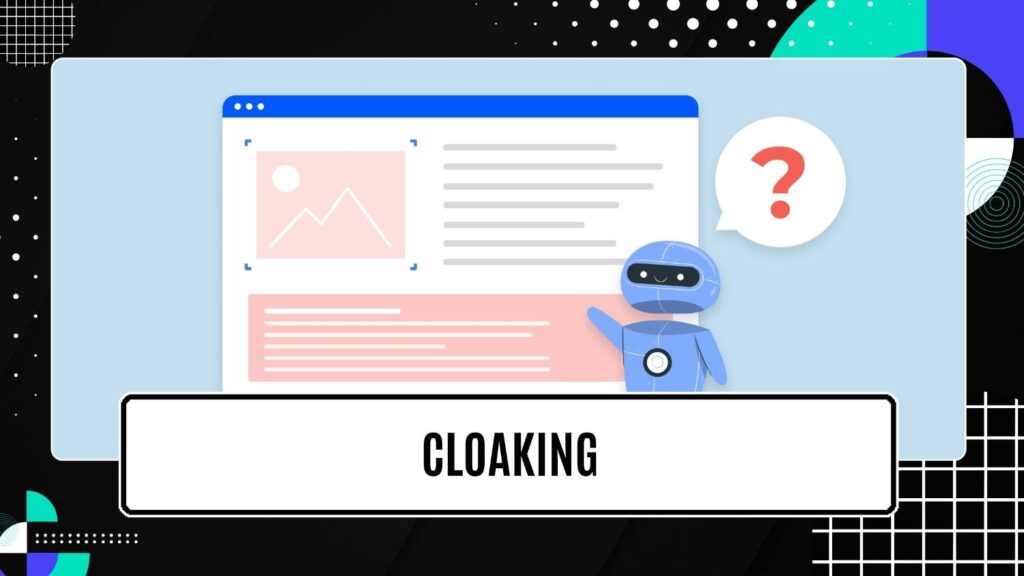
Cloaking shows one version of a page to crawlers and a completely different one to people. A site might feed Google a page full of relevant text while serving visitors something unrelated, low quality, or outright deceptive. Search engines treat this as a flat violation of their guidelines because it breaks the trust between what gets indexed and what actually loads. Of all the black hat tactics, cloaking is one of the quickest ways to pick up a manual penalty, and those are rarely fast to shake. Show everyone the same honest page, human or bot, and this one never becomes your problem.
3. Hidden Text and Hidden Links

Hidden text and links try to feed keywords to crawlers without messing up the page people see. The usual tricks are white text on a white background, fonts shrunk down to nothing, text pushed off the edge of the screen, or a link wrapped around a single invisible character. The idea is to move rankings while the visible page stays clean. Trouble is, search engines render pages much the way a browser does, so this stuff is easy to catch and penalise. If a piece of content is worth including, it should be visible and useful to the people reading your site. Anything you feel you have to hide is usually a sign it is not worth doing.
4. Doorway and Gateway Pages

Doorway pages exist only to rank for specific searches and then shove visitors somewhere else. Picture dozens of near-identical pages, each built around a slightly different city or phrase, all funnelling people to the same place. They do nothing for the reader and exist purely to game the system.
Google goes after this behaviour directly, and sites that lean on doorways often watch whole sections vanish from the index overnight. One genuinely useful page will beat a hundred thin doorways every time, so put your effort where it counts and build pages people are happy to land on. If you cover several locations, give each one a real page with information specific to that place, not a template with the city name swapped out.
5. Manipulative Link Schemes and Paid Links

Links are still a strong ranking signal, which is why so much black hat effort goes into manipulating them. This covers buying links that pass authority, paying into private blog networks set up purely to inflate rankings, and trading links in bulk to fool the algorithm. The risk is high: link penalties hit hard and can take months to recover from, sometimes longer.
Earn your links the slow way, through content worth citing, original research, and real relationships, and your authority will hold up no matter how closely the search engines look.
6. Spun, Scraped, and Duplicate Content

Content manipulation is another common one, and it tends to take one of three shapes. Article spinning pushes existing text through software that swaps in synonyms, leaving you with clumsy, barely readable pages. Scraping lifts whole articles from other sites and republishes them as yours. Duplicate content just repeats the same material across page after page on a single site.
None of it adds anything original, and all of it invites trouble. These tactics can fill a site fast, but what search engines actually reward is originality and real expertise. Write something worth reading, and you will never need a shortcut that falls apart the moment a reviewer or an algorithm looks closer.
7. Comment and Forum Spam

Dropping links into blog comments, forums, and unmoderated profiles used to be a quick way to scatter backlinks around the web. Automated tools still fire off thousands of them a day, hoping a few stick and lift the target site. In practice, these links are low quality, easy for search engines to ignore, and a quick way to get lumped in with known spam networks.
As black hat tactics go, this one is among the laziest, and it hurts your reputation as much as your rankings while irritating the exact communities you want on your side. Show up with something useful to say instead, and the links you earn will be ones you are glad to have.
8. Sneaky Redirects

Redirects are a normal part of running a site, until they are used to deceive. A sneaky redirect points a search engine at one page while sending real visitors off to a different one, often unrelated or outright harmful. Some setups even key off the device, slipping mobile users onto spam pages while desktops see something harmless.
That is deception, plain and simple, and search engines come down hard on it once they catch it. Use redirects only for honest reasons, like a page that moved or content you have merged, and always send bots and people to the same place.
9. Negative SEO Attacks

Negative SEO turns the playbook on its head, aiming the manipulation at competitors instead of your own site. Someone might fire thousands of toxic links at a rival, copy their content all over the web, or even hack the site to plant hidden spam. The target is someone else, but getting mixed up in tactics like these carries real legal and ethical risk on top of the damage to your name. Put your energy into your own site instead. Check your backlink profile regularly for anything suspicious, and disavow whatever looks harmful. Competing on quality is always the smarter, safer game.
Why These Techniques Are Never Worth the Risk

It is easy to look at these shortcuts and feel the pull, especially when a competitor seems to be getting away with one. But search engines pour enormous resources into catching manipulation, and they keep getting better at it.
A ranking won by deception is living on borrowed time, and when the penalty does land, recovery can mean months of slow cleanup, or in the worst cases it never fully comes back. The short-term lift is rarely worth the long-term hit to a brand. Once a domain gets a name for cutting corners, rebuilding trust with users and search engines can take far longer than the gains ever lasted.
White hat work, by contrast, compounds. Useful content, a fast and secure site, a sensible structure, links earned on merit: these add up to something that grows steadily and survives every algorithm update. The businesses that win in search are not the ones chasing loopholes. They are the ones that stay honest with their audience and the search engines, year after year.
Also read: Web Security for SEO: How to Secure Your Site and Boost Traffic
Conclusion
Steering clear of these nine traps protects the time, money, and reputation you have put into your site. Every one of them offers a shortcut that eventually caves in and takes your hard-won rankings with it. Real growth comes from the slower, harder work, and the reward is a place in search that nobody can yank out from under you.
Treat each of the nine above as a warning sign, audit your own site honestly against the list, and you are already ahead of every competitor still betting on shortcuts. The safest path tends to be the most profitable one in the long run.
Want to grow your rankings without the risk? Get in touch with our team, and we will build you a white-hat strategy designed to protect your site and keep it climbing for the long haul.